Turn curiosity into capability.
Nexus runs small, hands-on workshops where young people learn modern technology as a craft, work with the same real tools and real code working engineers use, and find out for themselves whether engineering is a fit. Everyone walks out having built something real—and understanding how it works.

Most coding programs teach a narrow slice through a sandbox. Nexus teaches real engineering as a craft—hardware, software, networks, and everything between—through small workshops, real tools, and projects that actually work when you're done.
Engineering is a craft, and like any craft it fits some people beautifully and leaves others cold—and both of those are completely fine. Someone who tries it and decides it isn't a fit has still learned something genuinely valuable: a little more about what does.
So Nexus keeps it honest. Workshops are a hands-on look at what this work actually is—the real tools, the real thinking, the real satisfaction of making something work. Each person gets to try the craft on and find out, for real, whether it clicks. No pressure to become an engineer.
Come find out if engineering is for you. No pressure to become an engineer—just a genuine chance to discover the craft and pick up skills that travel anywhere.
The whole development spectrum.
Workshops are built around the learner's interests. Pick a discipline, or mix several. Each area maps to real projects you can build, real tools used by working engineers, and real careers you might one day pursue.
Embedded Systems
Microcontrollers, sensors, motors, and firmware. The code that runs inside everything from a coffee maker to a satellite.
Signal & RF
How information travels as waves—radio, audio, light. The physics of communication and the math that makes it work.
Web Development
Frontend, backend, full-stack. From a static page to a database-driven app that serves real users.
Mobile Apps
iOS and Android, native and cross-platform. The whole journey from "I have an idea" to "it's on my phone."
Networking
How computers talk to each other. Protocols, sockets, packets—the invisible plumbing of the internet, made visible.
Game Design
2D and 3D games, mechanics, physics, and the engines underneath. From paddle-and-ball to something genuinely fun.
Robotics
Hardware and software working together. Motors, sensors, control loops—and the code that makes them act with purpose.
Systems & More
Architecture, design, integration—plus signal processing, data, security, and whatever else the workshop calls for.
See the whole field before choosing a path.
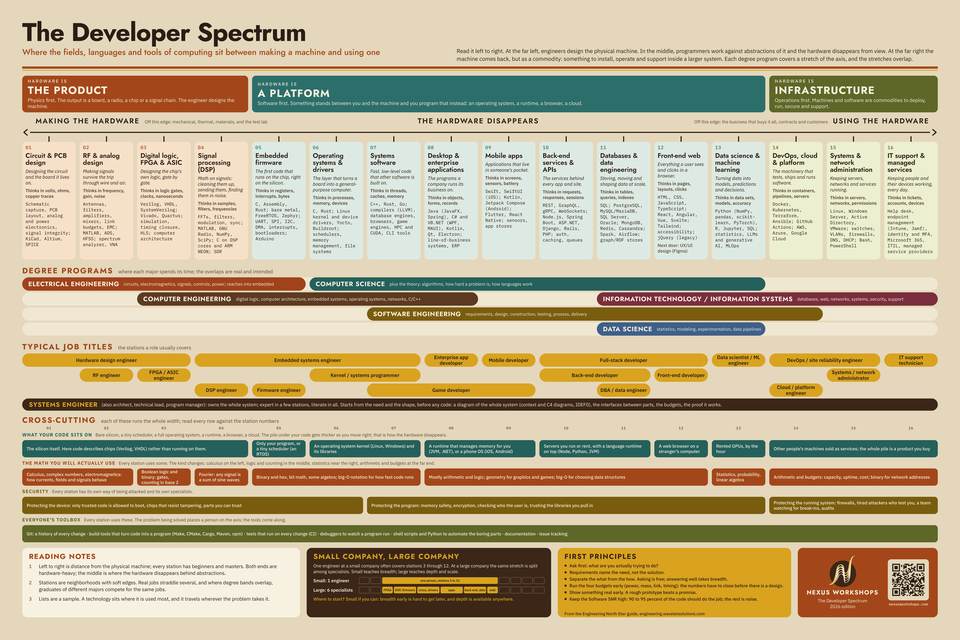
Computing is one of the widest fields there is, and from the outside it can look like a single job. The Developer Spectrum lays it out on one line, from designing the physical machine to running the systems built on top of it, so every degree, job, and technology has a place a student can point to.
It grew out of years in the classroom, helping students see what was out there and where their own curiosity fit. It has been the opening conversation in workshops and mentoring ever since.
Get the Poster →What a degree really opens up
Electrical engineering, computer engineering, computer science, software engineering, IT, and data science each cover a stretch of the field, and those stretches overlap. Students see what each program prepares them for and where graduates of different majors land in the same jobs.
Where the classroom meets the tools
Every language and technology sits at the station where it does its work, right alongside the degree that leads there. Verilog, C, Python, SQL, Kubernetes: each one has an address, and the coursework finally connects to something real.
Many lenses on one problem
An RF engineer, a back-end developer, and a network administrator can look at the same system and see three different things. The spectrum shows why: knowledge, education, and experience shape the questions each person asks.
What a systems engineer carries
One role spans the whole width. The systems engineer is expert in a few stations, literate in all of them, and starts from the need and the shape of the whole system before any code is written.
How much math, and which kind
Calculus and electromagnetics at the hardware end, logic and counting in the middle, statistics toward data, and arithmetic and budgets where systems run. Students see the math that matches the path they are drawn to.
Breadth, depth, and where to start
At a small company one engineer covers a dozen stations; at a large one, six specialists split the same ground. The poster helps a student weigh the two and see why breadth early pays off for a lifetime.
A conversation starter for a classroom, a lab, a robotics team room, or the wall of a student deciding what to study next.
Visit the Shop →Available on request.
Both workshops run whenever a small group is ready. Reach out with a learner or two and we'll set the dates together.
Building Things With Code
An introductory experience where young learners discover how computers actually work—then use that knowledge to build a working game from the wire up. Hardware, code, and a custom game controller each learner builds and takes home.
Talking in Light
Learners build a working optical modem from scratch—an LED, a light sensor, an Arduino—then write a desktop chat app in C# so two computers hold a real conversation across nothing but a beam of light.
Four things that set us apart.
Small cohorts
Workshops are intentionally small. The instructor knows each learner, watches how each one thinks, and adjusts the pace to fit.
Real tools
No proprietary platforms or sandbox languages. Learners use the actual tools and languages working engineers use every day.
Build to keep
Every workshop ends with something real—hardware, code, or an app—that students take home and can show off.
An honest fit
This is a chance to try the craft on. If it clicks, there's a whole spectrum to explore. If it doesn't, that's a real answer too.
Taught by Eric Ratliff.
Nearly thirty years building systems that have to work the first time—from radios in space to machine learning in the field. The kind of range that means whatever a learner wants to build, there's deep, real experience behind the teaching.
More about Eric & the full spectrum →A whole toolbox for learners.
Beyond the workshops, Nexus builds and publishes open-source tools, field guides, and references at nxlearn.net—the technical home base for learners who want to keep going. Free to use, study, and build on.
Clean, testable FTC robot projects in one command. No more fighting the SDK.
Arduino projects scaffolded with sensible defaults and cross-platform builds.
A from-scratch guide to UDP networking, databases, and visualizing real robot data.
Curious whether it's a fit?
Cohorts are small and sessions are set on request. Call, text, or email with questions or to sign up—and if you'd like, we can meet for a few minutes first, no commitment, so you can get a feel for it before deciding.
Send a Message →